L'ART ET LA VIE - L'ART ET LA VIE - L'ART ET LA VIE -
L'ART ET LA VIE - L'ART ET LA VIE - L'ART ET LA VIE -
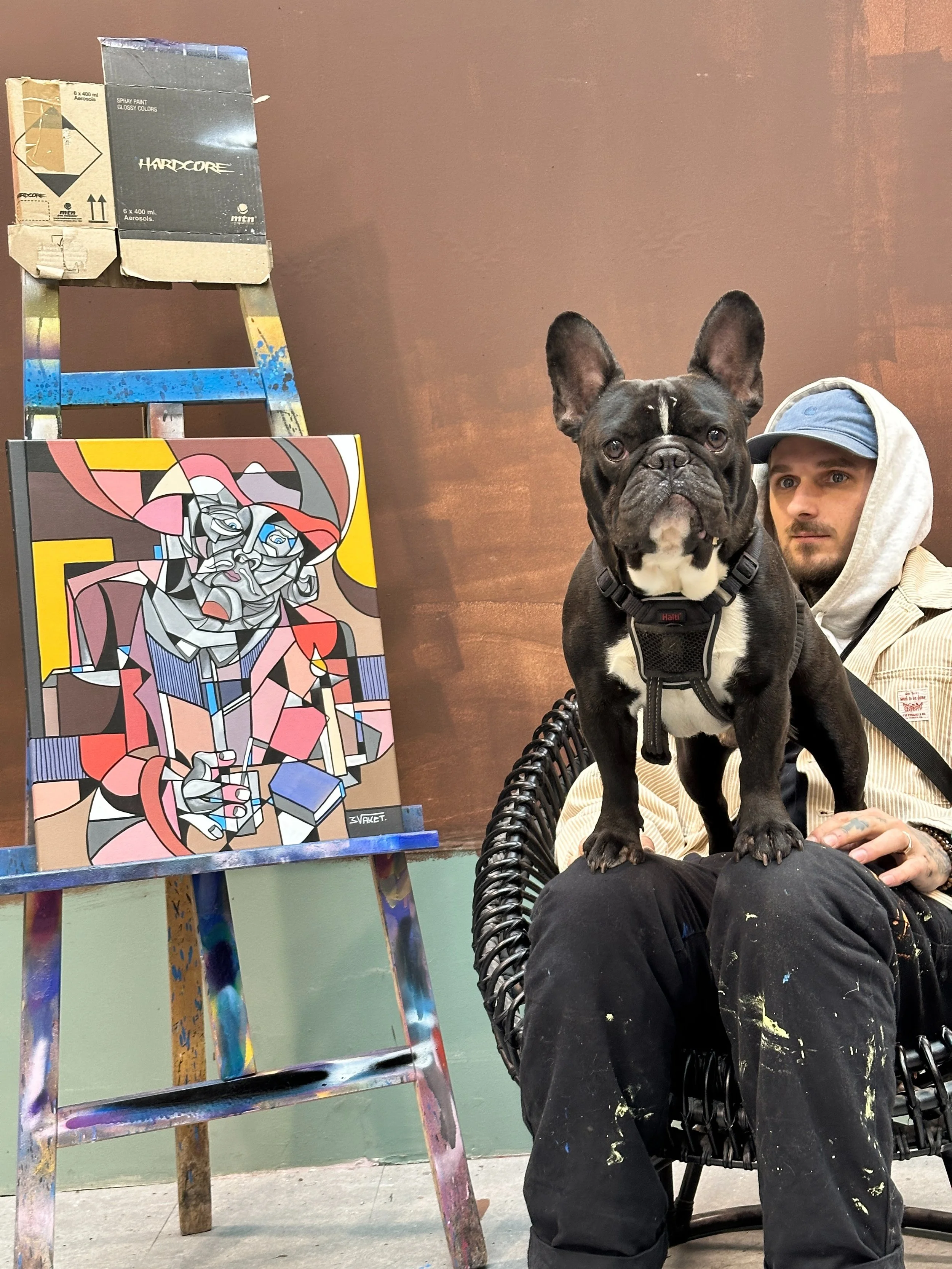
3v aket kubic , l’art et la vie by amélie adamo (LINKEDIN)
With the freedom of a self-taught artist, 3V Aket kubic has been exploring the world of painting since the age of 27. Energetic and curious, he explores the universe of forms and colors with pleasure and eclecticism, unconcerned with categories and aesthetic divisions. Of course, at its core, there is his childhood dream, his passion for drawing and comics, and then, in high school, the discovery of B-boys, the practice of dotwork proliferating in his notebooks, which he calls "Black Book," and the collective emulation gained through the experience of graffiti, which Aket shares with others on the walls of Dunkirk and Lille. But there is also the discovery of modern and contemporary art. 3V Aket kubic's imaginary museum is vast, encompassing artists from Pablo Picasso to Georges Condo, from Fernando Botero to Bernard Buffet, from Jean-Michel Basquiat to Robert Combas. What does he share with these masters? A predilection for the human figure and the art of portraiture, a taste for the energy of color and the expressiveness of drawing, a quest for simplification and formal deconstruction, a creative freedom that allows for all kinds of technical experimentation, hybridizing styles and references. A chronicler of everyday life, 3V Aket kubic observes the world around him. Whether it's words from a song or a popular expression, a childhood memory, a trip, or a simple scene from daily life, Aket draws inspiration from his immediate surroundings. These reminiscences of life collide and intertwine with diverse artistic references: high culture and popular culture, traditional and contemporary, all blended together. Thus, in his works you might encounter the tutelary figure of a deceased artist as well as that of a living politician; you might meet the figure of a musician you met at the local bar or a fisherman seen on the port of Dunkirk, as well as a Napoleon on horseback, a cartoonish Donald Duck, or a Samurai from a Japanese print. 3V Aket kubic’s style is hybrid.
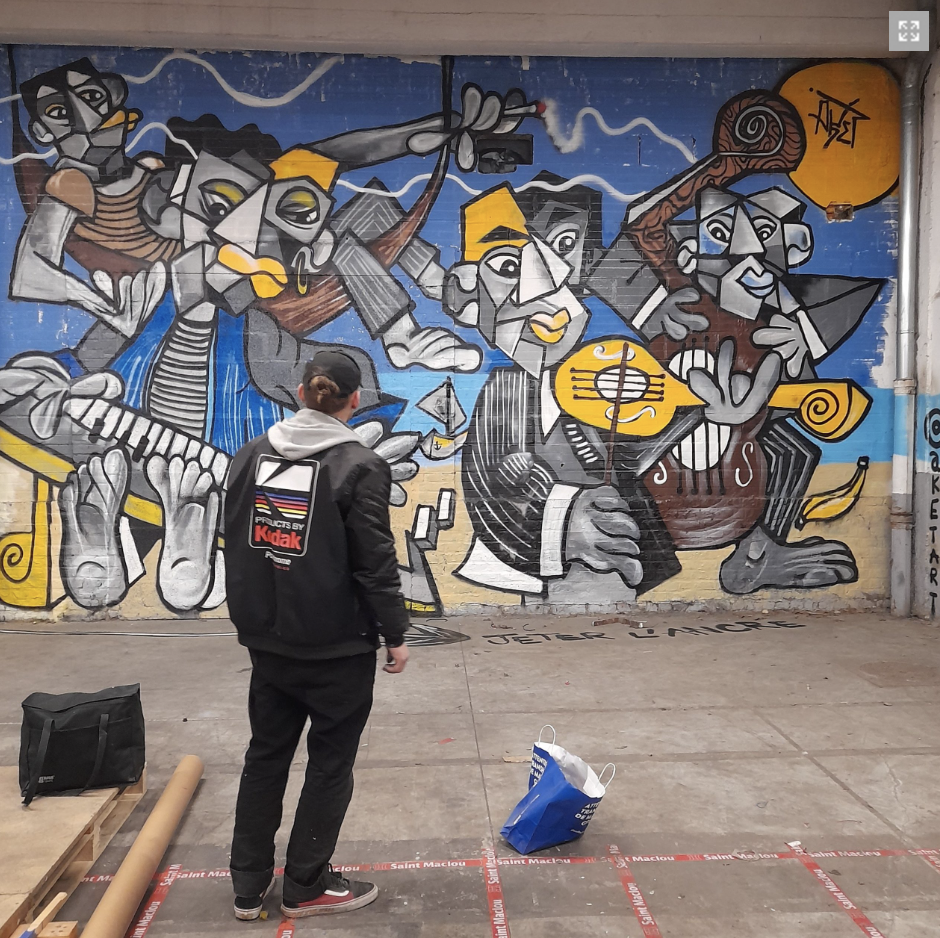
And if he merges iconographic motifs within a single work, he does the same with writing. Here, his practice can be "dirty," raw, expressionistic, done with a brush or spray can, playing with lettering derived from graffiti, textural effects, drips, and splashes, with a gestural freedom and a seemingly childlike spontaneity. There, a cleaner style of writing, with precise strokes, clean lines, and carefully applied flat tints. A hybridity that 3V Aket kubix draws from his dual experience in graffiti and contemporary art. Thus, his way of playing with geometric and isometric forms, which can be interpreted as a form of neo-Cubism, owes even more to graffiti lettering and B-boys, in their way of creating a three-dimensional perspective. While Aket's work features recurring themes, such as the figure of the clown and the musician, animals, motifs inspired by the world of Versailles or Japan, and scenes of daily life, the artist enjoys varying them, transforming them into a pretext for playing with forms, evolving his style, and exploring and mixing techniques. There is freedom and pleasure in his practice, a bit like a jazz musician improvising or a DJ sampling existing material to create something entirely new in his own style. Thus, 3V Aket kubic enjoys exploring the expressive possibilities of gray, which forms the basis of his signature style, with a masterful use of color, just the right amount, as seen in his portraits of clowns whose gray faces are enhanced by vibrant colored backgrounds, or in his works where the intensity of blue makes an appearance in multiple variations. Sometimes gray is mixed with greater complexity, as evidenced by the "stained-glass" compositions where Aket significantly diversifies his palette, finding rich resonances.
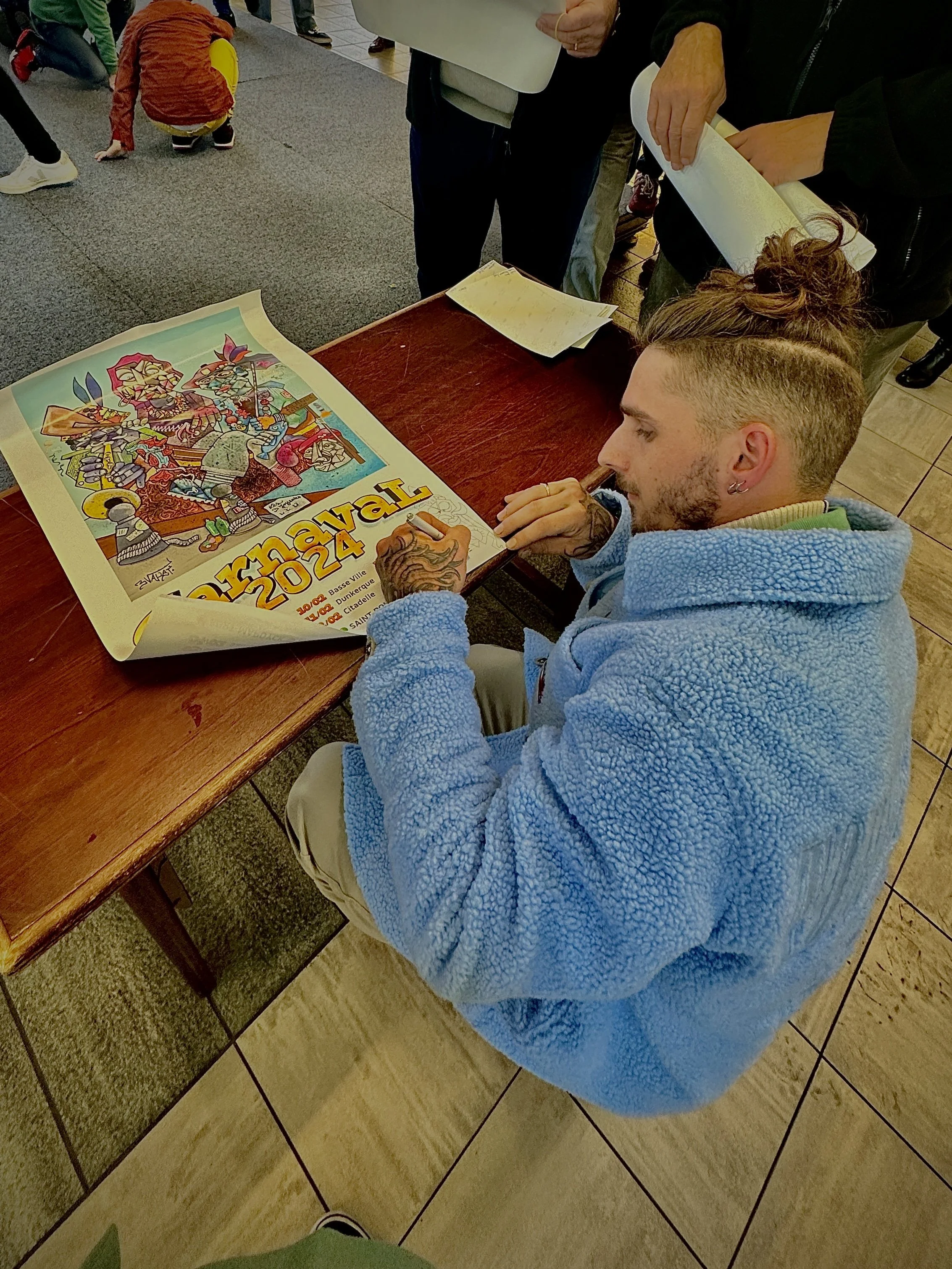
Whether depicting scenes of daily life or representations of animals and bullfighting enthusiasts, 3VAket kubic delights in exploring the complexity of compositions where figures and backgrounds, settings, objects, and landscapes intertwine, collide, or merge, in rhythms and movements that are sometimes fluid, sometimes more aggressive. 3V Aket kubic has recently developed this dynamism and complexity of composition, sometimes by combining several canvases in a monumental format with multiple color harmonies, and sometimes by pushing his 3D approach to canvas by incorporating wooden elements, creating volume and giving the paintings a more sculptural aspect. Through this hybrid style, this interplay with geometric forms that fragment the image, this expressiveness of color, and this dynamism and interweaving of compositions, 3V Aket kubic world conveys a critical and poetic vision of society and human relationships. Between humor, irony, and poetry, this fragmented and disjointed vision captures the madness of the endless flow and the aggressive fragmentation of the modern world: rampant capitalism, pollution, war, consumerism, oppression, loneliness, and everything that alienates and violates the individual today. But this vision, in its curved lines and vibrant colors, also evokes the tranquil flow of daily life, the gentleness of the small things humanity shares, the creative breath of love, art, and music. Like a hyphen spray-painted on city walls—a gratuitous, spontaneous, and free act—this breath is a vital energy that connects people.